
Sandalwood is usually warm, smooth, creamy, and slightly sweet. Cedarwood is usually dry, crisp, clean, and less sweet. Sandalwood is often easier for dates, evenings, and close indoor settings. Cedarwood is often easier for work, daytime, and warm weather. Neither note automatically lasts longer. The full formula matters more than the wood name.
For one versatile wood perfume, look for a blend of both. Cedarwood can keep the scent clean and structured, while sandalwood can stop it from becoming too dry. The best choice is the fragrance that still smells balanced after four hours, not simply the one with the strongest opening.
A perfume note list describes the intended smell, not the full ingredient formula. A product labeled “sandalwood” may use natural sandalwood oil, synthetic sandalwood materials, or a blend of several ingredients. The same applies to cedarwood. XUELEI's guide to the perfume manufacturing process explains how natural materials, synthetic materials, solvents, testing, and production all affect the finished scent.
Sandalwood
Sandalwood usually smells smoother and warmer than cedarwood. Common impressions include soft wood, warm skin, cream, mild spice, clean musk, incense, and a small amount of sweetness.
Alpha-santalol and beta-santalol are two of the main compounds linked to the characteristic woody smell of sandalwood oil.[1] However, natural sandalwood oils do not all smell identical. The species, growing region, extraction method, age, and storage conditions can change the result.
Modern perfumes also use synthetic sandalwood materials. These can make the scent creamier, cleaner, stronger, or more consistent from one production batch to another. This is why two perfumes that both list sandalwood may smell very different.
In a perfume, sandalwood can:
- Soften sharp spices, leather, or dry woods
- Connect the middle notes to the base
- Add warmth to musk, amber, or floral notes
- Create a smoother and less abrupt dry-down
Sandalwood is often soft, but it is not always quiet. When combined with pepper, incense, leather, smoke, or strong modern woody materials, it can become dry, dark, or powerful.
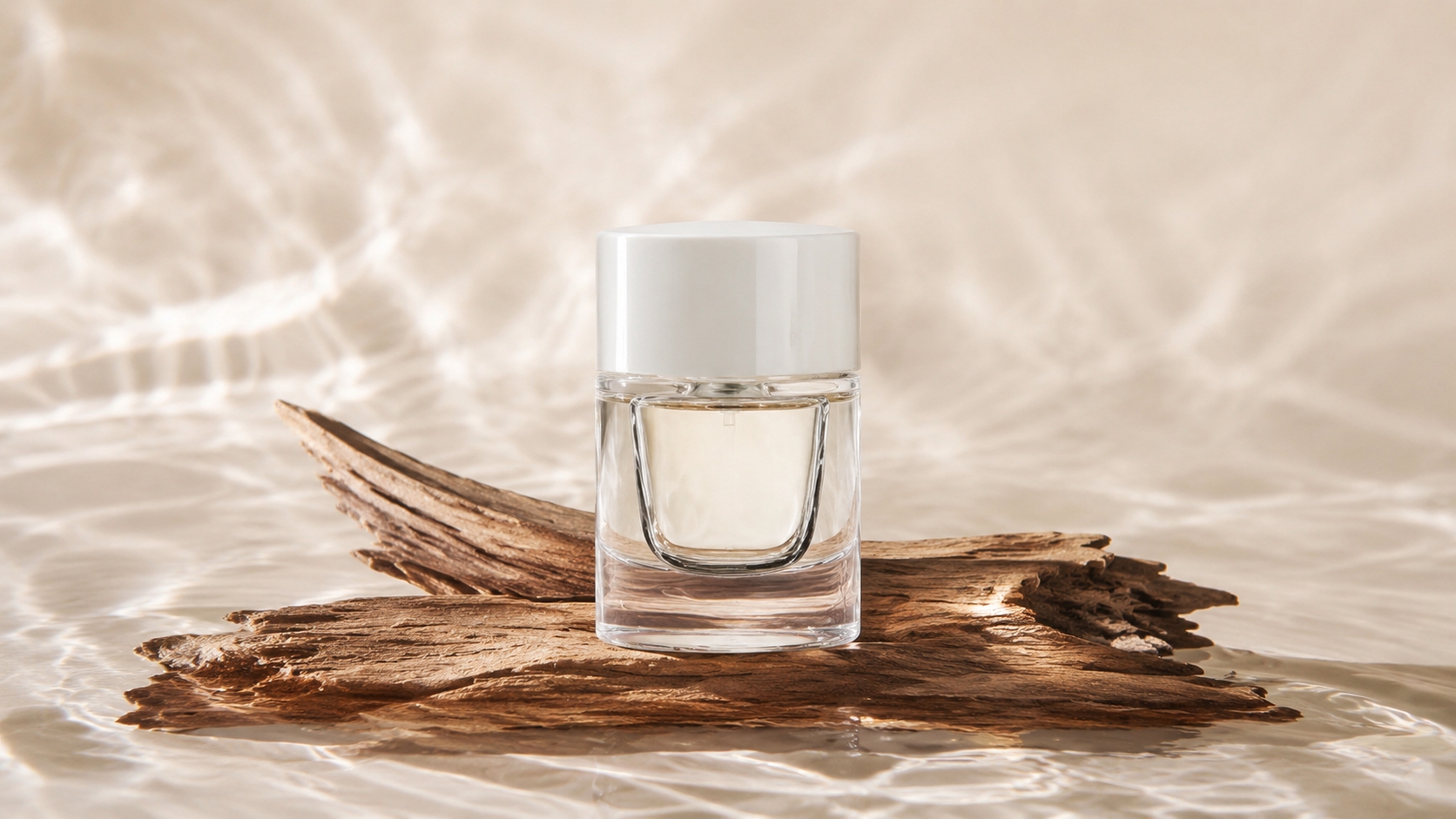
What Sandalwood Smells Like
- Creamy: Soft, milky, and rounded
- Warm: Similar to warm skin or polished wood
- Musky: Clean and close to the body
- Spicy: Often supported by cardamom or pepper
- Smoky: More noticeable when paired with incense
- Powdery: Common when sandalwood is paired with iris
“Polished wood” does not mean paint or furniture cleaner. It describes wood that smells smooth and finished rather than rough or freshly cut.
Best Notes with Sandalwood
When Sandalwood Works Best
Sandalwood is commonly suitable for:
- Dates and dinners
- Autumn and winter evenings
- Weddings and social events
- Quiet indoor settings
- Wearers who prefer low sweetness with a soft finish
Fresh sandalwood perfumes can also work during daytime and summer. Tea, citrus, iris, green fig, and light musk can make sandalwood feel cleaner and less heavy.
The main risk is too much softness. If sandalwood is surrounded by thick vanilla, amber, cream, and musk, the wood may disappear. After four hours, check whether a clear wood texture remains or whether the perfume has become only sweet musk.
Cedarwood
Cedarwood usually smells drier and sharper than sandalwood. Common impressions include pencil shavings, dry timber, bark, sawdust, wooden drawers, smoke, earth, and resin.
“Cedarwood” is a broad trade name rather than one identical botanical material. Oils sold as cedarwood can come from different plant sources. Virginia cedarwood oil, for example, is associated with compounds such as cedrene, thujopsene, and cedrol.[2]
This is why one cedarwood perfume may smell like clean pencil shavings while another smells smoky, oily, earthy, or warm. A modern cedarwood scent may also be built with natural oil, synthetic woody materials, musk, amber, vetiver, patchouli, or sandalwood.
In a perfume, cedarwood can:
- Reduce the impression of sweetness
- Give soft notes a clearer shape
- Add dryness to amber and musk
- Support citrus, lavender, and other fresh notes
- Create a clean and structured base
What Cedarwood Smells Like
- Pencil-like: Dry, sharp, and easy to recognize
- Woody: Similar to dry timber or a wooden drawer
- Earthy: More noticeable when paired with vetiver or patchouli
- Smoky: Common in incense or leather blends
- Resinous: Warmer and less dusty
- Clean: Often created with citrus, lavender, and musk
A good cedarwood fragrance uses dryness to give the scent shape. A weak one may smell dusty, thin, or like pencil shavings from beginning to end.
Best Notes with Cedarwood
When Cedarwood Works Best
Cedarwood is commonly suitable for:
- Offices and business meetings
- Daytime wear
- Spring and autumn
- Mild summer weather
- Formal or simple clothing
- Wearers who dislike sweet perfume
Cedarwood with bergamot, lavender, or vetiver can work as an everyday scent. Cedarwood with leather, incense, patchouli, or amber usually feels darker and more suitable for evenings or cooler weather.
The main risk is too much dryness. A balanced cedar perfume needs enough freshness, musk, warmth, or depth to stop it from becoming thin and dusty.
Sandalwood vs Cedarwood
These are common patterns, not fixed rules. A sandalwood perfume can be dry when it contains vetiver or incense. A cedarwood perfume can be warm when it contains amber, musk, vanilla, or sandalwood.
Longevity
Neither sandalwood nor cedarwood automatically lasts longer. Longevity depends on the complete formula, the amount applied, the materials used in the base, skin conditions, clothing, temperature, and airflow.
It is useful to separate two questions:
- How long can any part of the perfume still be smelled?
- How long can the sandalwood or cedarwood still be recognized?
A perfume may remain on the skin for eight hours while the clear wood note disappears after four hours. The remaining smell may be mostly musk, amber, or vanilla. This means the perfume lasts, but the wood does not remain clear for the full wear.
The terms Eau de Toilette, Eau de Parfum, and Parfum are not fixed by one international concentration standard. IFRA lists common market ranges but explains that brands and regions may use the terms differently.[3]
As a result, an Eau de Parfum is not guaranteed to last longer than every Eau de Toilette. Two products with the same concentration label can perform very differently.
XUELEI's perfume concentration guide explains the common concentration ranges and why concentration alone does not determine projection or longevity.
Projection and Sillage
Longevity means how long the perfume remains detectable.
Projection means how far the scent travels from the body.
Sillage means the scent trail left as the wearer moves.
A sandalwood perfume can last for many hours while staying close to the skin. A cedarwood perfume may project clearly during the first hour and then become much quieter.
Heat, body movement, clothing, humidity, and ventilation can change projection. A perfume may seem quiet while sitting but become stronger when walking or entering a warm room.
Repeated exposure to the same smell can also reduce how strongly it is noticed. This is known as nose or smell adaptation.[4] Before spraying again, move into fresh air and ask another person whether the fragrance is still noticeable.
How to Judge Sophistication
A sophisticated wood perfume does not need to be expensive, very strong, or made only with natural ingredients. It should smell controlled and complete.
Check these six points:
- Clear direction: The main scent is easy to understand.
- Good balance: Sweetness, dryness, smoke, leather, and musk do not fight each other.
- Smooth change: The opening, middle, and base feel connected.
- Useful texture: Sandalwood does not become shapeless, and cedarwood does not become painfully dusty.
- Clean dry-down: The final stage does not smell sour, burnt, metallic, or flat.
- Suitable strength: Projection matches the setting.
A simple cedarwood, bergamot, and musk perfume can smell more refined than a crowded fragrance with many competing notes. Price, packaging, and a long note list do not guarantee better quality.
Work, Dates, and Formal Events
For work: Choose moderate projection, low sweetness, and a clean dry-down. Cedarwood with bergamot, vetiver, lavender, or musk is often suitable. Sandalwood can also work when paired with iris, tea, or dry spice.
Heavy smoke, thick amber, sweet vanilla, tobacco, and oud-style blends need more careful application in shared spaces. The amount applied matters more than the note name. Some workplaces may also have fragrance-free rules.
For dates: Sandalwood is often easier because it feels warm and smooth at close range. Cardamom, musk, iris, amber, and soft leather are useful supporting notes. Cedarwood can also work when warmed with sandalwood, amber, musk, or leather.
For formal events: Cedarwood gives a cleaner and stricter style, while sandalwood gives a softer and richer style. Indoor events usually need less projection than outdoor events.
Summer and Winter
Summer: Look for cedarwood with bergamot, grapefruit, vetiver, lavender, or green notes. Light sandalwood with tea, citrus, iris, or green fig can also work well. Heavy vanilla, resin, tobacco, and thick amber may become tiring in hot or humid weather.
Winter: Sandalwood works well with cardamom, amber, incense, or leather. Cedarwood works well with patchouli, smoke, dark vetiver, musk, or leather.
Cold outdoor air can make a perfume seem quieter, but heated rooms may make it strong again. Coats and scarves can hold perfume for several days, so repeated spraying may create more buildup than expected.
Skin, Clothing, and Application
Fragrance performance varies from person to person. Skin temperature, perspiration, skin oil, body products, weather, and application area can all change how a perfume smells.
An unscented moisturizer may help some perfumes remain more noticeable on dry skin, but it does not guarantee longer wear. Allow the moisturizer to absorb before spraying.
Perfume often lasts longer on fabric, but fabric does not provide the same heat as skin. A scent on clothing may stay closer to its opening and show less change over time.
Use care with:
- Silk
- Suede
- Leather
- White shirts
- Delicate or coated fabrics
Perfume oils and colorants may leave marks. Test a hidden area first.
For the first full wear, start with one or two sprays. Increase by one spray on a later wear only when the fragrance is clearly too quiet for the intended setting.
Useful application areas include the upper chest, side of the neck, back of the neck, and inner elbows. Do not spray near the eyes, mouth, or damaged skin.
How to Test a Wood Perfume
XUELEI recommends testing under similar conditions rather than relying on a quick store impression.
- Use the same number of sprays for each perfume.
- Do not test over scented lotion or soap.
- Test no more than two serious choices on skin at once.
- Use separate paper strips for the first comparison.
- Test the final choices during a normal workday or weekend.
Check the perfume at four useful points:
A sample is usually more useful than spending another 30 minutes at a perfume counter. Test it in warm and cool conditions, on a normal day, and in the setting where it will actually be worn.
Natural and Synthetic Materials
A modern wood perfume may contain natural oils, synthetic aroma materials, or both.
Natural oils can vary between species, growing regions, extraction methods, and batches. Synthetic materials can help control strength, smoothness, cleanliness, and consistency.
“Synthetic” does not automatically mean cheap. “Natural” does not automatically mean safer, better, or more sustainable. The finished formula should be judged by smell, balance, stability, safety, and responsible sourcing.
A sandalwood or cedarwood scent blend may include:
- Natural sandalwood or cedarwood oil
- Synthetic woody materials
- Musk
- Amber materials
- Vetiver
- Patchouli
- Spices
- Resins
For brands developing a wood fragrance, XUELEI's custom perfume manufacturing service covers scent development, bottle design, packaging, production, and quality control. Brands preparing a first launch can also review the guide on how to build a perfume brand.
Storage
Store perfume upright in a cool, dark, and stable place.
- Keep it away from direct sunlight.
- Do not leave it in a hot car.
- Keep it away from radiators.
- Avoid bathrooms with frequent heat changes.
- Replace the cap when the bottle has one.
A small color change does not always mean that a perfume is unusable. A sour, rancid, or sharply changed smell is a more important warning sign.
Safety
Fragrances can cause irritation or allergic reactions in some people. The FDA notes that cosmetic allergies often appear as itchy, red skin or contact dermatitis.[5]
Natural fragrance materials can also cause reactions. Labels such as “natural,” “clean,” or “essential oil” do not mean allergy-free.
IFRA Standards can prohibit, restrict, or set conditions for the use of certain fragrance materials. An IFRA Certificate of Conformity confirms compliance for an intended use, but it does not replace a full safety assessment or national laws.[6]
Cosmetics sold in the European Union are subject to Regulation (EC) No 1223/2009, which covers matters such as product safety, responsible persons, product information, and labeling.[7]
Regulation (EU) 2023/1545 expanded the EU rules for individually labeling specified fragrance allergens when the relevant thresholds are exceeded.[8]
People with sensitive skin should:
- Try a small amount first.
- Avoid recently shaved or irritated skin.
- Stop using the perfume if burning, swelling, itching, or a rash appears.
- Seek medical advice for a severe or lasting reaction.
A small personal test is not the same as a medical patch test. Perfume should also be kept away from the eyes, mouth, children, damaged skin, and open flames.
Buying Checklist
- Is the four-hour dry-down still pleasant?
- Can the wood still be recognized if a wood-led scent is wanted?
- Is it too sweet, dry, smoky, powdery, or musky?
- Is the projection comfortable for the main setting?
- Has it been tested on skin during a normal day?
- Does it suit the local weather?
- Does it duplicate a perfume already owned?
- Would a sample or smaller bottle be enough?
- Would it still be chosen without the brand name or bottle design?
- Will it realistically be worn often?
Common Questions
Is sandalwood masculine?
Sandalwood has no fixed gender. Cardamom, leather, pepper, vetiver, incense, and dry amber can give it a more traditional masculine style.
Is cedarwood more masculine?
Cedarwood is often seen as masculine because it is dry and direct, but it is also widely used in gender-neutral and feminine perfumes.
Which lasts longer?
Neither wins automatically. A sandalwood perfume with amber and musk may last longer than a fresh cedarwood perfume. A cedarwood formula using persistent modern woody materials may last longer than a soft sandalwood scent.
Which is better for work?
Cedarwood is often easier because it is usually dry and low in sweetness. Sandalwood also works when paired with tea, iris, clean musk, or dry spice.
Which is better for dates?
Sandalwood is often easier because it feels warm and smooth at close range. Warm cedarwood with musk, leather, amber, or sandalwood can also work well.
Why does cedarwood smell like pencils?
Some cedarwood materials have dry facets that resemble pencil shavings or wood dust. This is normal, but a balanced perfume should usually add freshness, warmth, musk, or depth.
Why does sandalwood smell sweet?
Sandalwood naturally has a soft and rounded smell. Vanilla, amber, musk, tonka-style notes, and creamy materials can make the sweetness stronger.
Can sandalwood and cedarwood be worn together?
Yes. Cedarwood adds shape and dryness, while sandalwood adds warmth and smoothness. This is often the most versatile option.
Final Choice
Sandalwood is the better starting point for a warm, creamy, and close-wearing scent. Cedarwood is the better starting point for a dry, clean, and low-sweetness scent. Neither note guarantees better longevity. Test at 15 minutes, 1 hour, 4 hours, and 8 hours, and give the four-hour result the most weight. Check whether the wood is still clear, whether sweetness or dryness remains comfortable, and whether the projection suits the main setting. A balanced blend of sandalwood and cedarwood is often the most flexible choice because it combines warmth with structure without becoming too sweet or too dusty.