
Chinese Perfume Heritage Scents | Osmanthus, Tea Notes
Chinese perfume heritage scents often use familiar materials such as osmanthus, tea, incense, wood, paper, and herbs. Osmanthus usually smells like apricot, yellow flowers, green leaves, honey, and soft suede. Tea can smell fresh, floral, roasted, woody, smoky, or earthy. Tea reduces the heavy sweetness of osmanthus, while osmanthus gives tea a clearer fruit-and-flower center.
This article explains what osmanthus and tea smell like, how these notes are built in perfume, and how to judge whether a fragrance matches its product description. Words such as “apricot,” “steam,” “paper,” and “suede” describe smell impressions. They do not prove that these physical materials are present in the formula.
For more background on local materials and modern fragrance development, see XUELEI’s guide to Chinese perfumes in the global market.
Chinese Scent Heritage in Modern Perfume
Fragrance in China was not limited to liquid perfume worn on the skin. Scent was also experienced through incense, aromatic woods, flowers, tea, food, scented sachets, clothing, furniture, and indoor spaces.
The way a material is used changes its smell. Burning wood creates smoke and ash. Gentle heating brings out softer woody and resinous notes. Fresh flowers smell greener and brighter than dried flowers stored with paper or fabric. Tea scented with fresh flowers also smells different from tea that only contains decorative dried petals.
Flower-scented tea is a useful example. During scenting, prepared tea is placed in contact with fresh flowers so the leaves absorb their aroma. Depending on the product, the tea may be mixed, rested, separated, dried, and scented again. Research on jasmine tea found that repeated scenting changed both the number and amount of volatile compounds and improved aroma strength and persistence.[1]
Another flower-scented tea study identified 25 key volatile compounds. Most increased when more fresh flowers were used, although adding more flowers did not always produce a better overall aroma.[2] This shows why scent quality depends on balance rather than the largest possible amount of one material.
Modern perfume can follow the same idea. The flower and tea should not always smell like two separate layers. The tea can carry part of the floral sweetness, while the flower takes on dry leaves, warmth, or light bitterness.
A Chinese-inspired perfume is usually clearer when it starts with one material or scene. A wet courtyard may suggest stone, leaves, soil, and flowers. A study may suggest tea, paper, ink, and dry wood. Adding tea, bamboo, lotus, rice, incense, and sandalwood to the same formula does not automatically make it more culturally meaningful.
The XUELEI Fragrance Museum covers traditional Chinese incense, perfume history, raw materials, extraction methods, and modern fragrance production.
What Osmanthus Smells Like
The fragrant osmanthus commonly discussed in perfumery is Osmanthus fragrans, known in Chinese as Osmanthus. Its flowers may be cream, pale yellow, gold, or orange. Different cultivars can have different smell profiles, and flowering stage, temperature, light, weather, and growing conditions can also affect the aroma.
Key osmanthus data: A study comparing three sweet osmanthus cultivars detected 54 volatile compounds. Only 17 were confirmed as aroma-active, including compounds such as β-ionone, linalool, and β-ocimene.[3]
This difference matters because a long chemical list does not explain the smell by itself. Some compounds are present in large amounts but have limited sensory impact. Others are present at low levels but are easy for the human nose to detect.
Osmanthus is usually described through five main smell groups:
- Apricot and peach skin: soft yellow fruit that may smell fresh, tart, dried, or preserved.
- Yellow flowers and pollen: a light floral smell rather than a thick white-flower effect.
- Green leaves: fresh leaves, stems, herbs, or a slightly bitter edge.
- Honey and wax: warm sweetness that is usually lighter than caramel or vanilla.
- Suede and dry tea: a soft leather-like or leafy texture that separates osmanthus from a simple peach scent.
Fresh flowers on a tree often smell airy, green, and far-reaching. Dried flowers may smell quieter and closer to hay, herbs, paper, or dried apricot. Osmanthus used in syrup or food may suggest honey and preserved fruit. Osmanthus tea adds dry leaves, steam, and light bitterness.
A perfume does not need all these effects. A fresh formula may focus on apricot skin and green leaves. A warmer formula may use dried fruit, honey, tea, and wood. A darker formula may bring out suede, tobacco-like dryness, or incense.
Why Osmanthus Often Smells Like Apricot
The apricot effect does not come from one ingredient. It is created by several aroma-active compounds working together.
Ionone-related materials can smell violet-like, woody, powdery, or softly fruity. Lactone-type materials can suggest peach skin, apricot flesh, creaminess, or warm skin. Floral materials add lift, while green and woody notes keep the fruit from becoming too sweet.
The amount of a compound is not the only factor. A substance present at a very low level may strongly affect the aroma if its odor threshold is also low. Researchers therefore use gas chromatography-olfactometry as well as chemical analysis. This method helps identify which compounds people can actually smell.
Perfumers may combine ionones, fruity lactone-type materials, jasmine materials, green notes, woods, and suede effects to build an osmanthus accord. Too much fruit can smell like peach shampoo. Too much powder can resemble violet makeup. Too much leather can hide the flower.
The right balance depends on the target: a living flower, dried osmanthus, osmanthus tea, an osmanthus dessert, or a darker creative version.
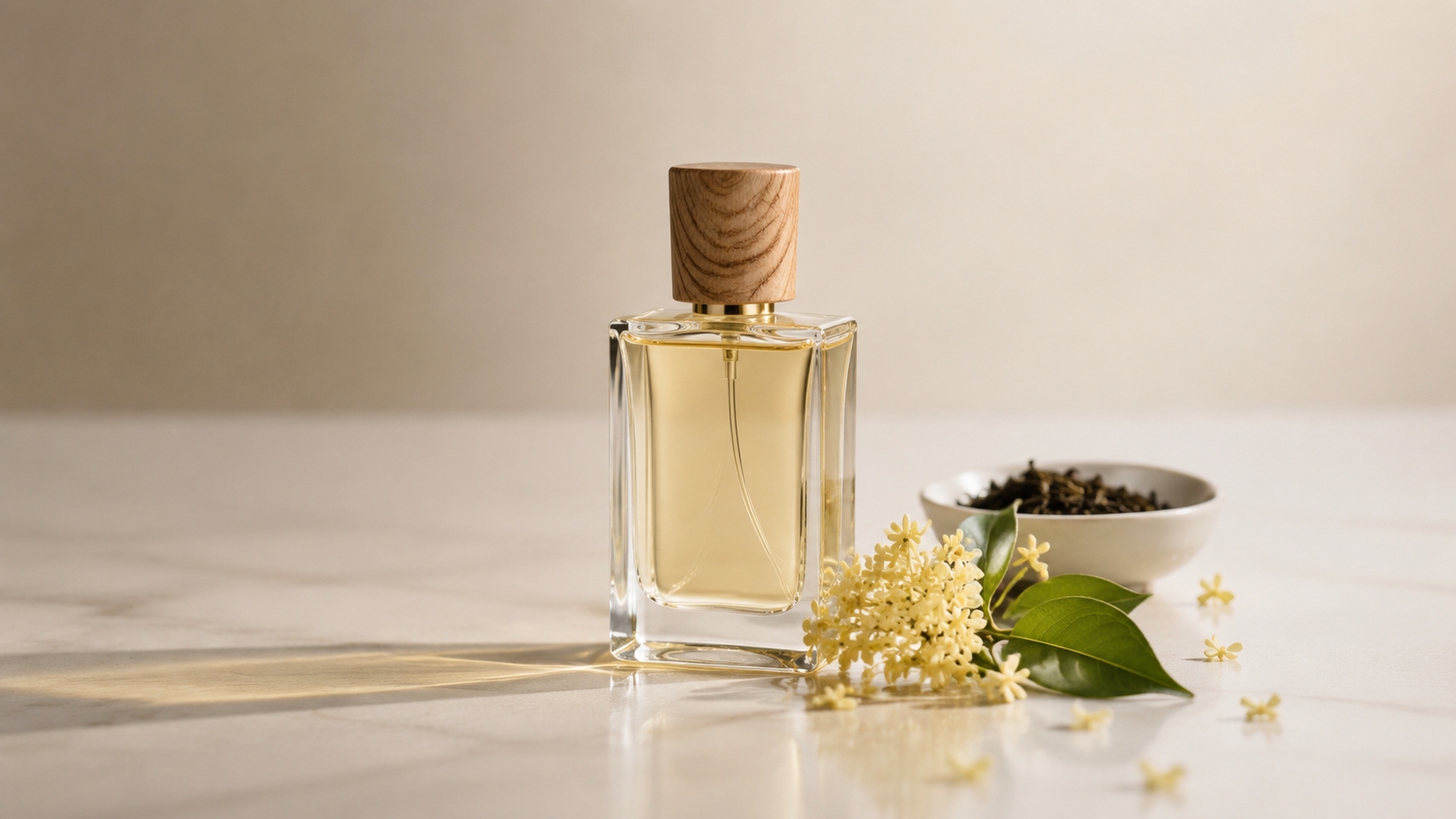
Natural Osmanthus and Osmanthus Accords
Natural osmanthus material is commonly produced through solvent extraction. The first waxy material is called a concrete. Further processing can produce an absolute.
Osmanthus absolute is concentrated and may smell darker, waxier, fruitier, or more leathery than flowers on a living tree. Some of the fresh air and green brightness of the flower may be reduced during extraction.
An osmanthus accord is a blend of materials designed to create a selected osmanthus smell. It may contain natural osmanthus, but it does not have to. An accord can be made fresher, greener, cleaner, fruitier, or easier to reproduce from one batch to another.
| Option | Main strengths | Common limits |
|---|---|---|
| Natural osmanthus absolute | Rich fruit, wax, suede, depth, and natural variation | Higher cost, darker color, supply variation, and a smell that may differ from fresh flowers |
| Reconstructed osmanthus accord | Better control of freshness, color, cost, strength, and batch consistency | Can smell flat or artificial when fruit, floral, and leather notes are poorly balanced |
| Natural material plus accord | Natural depth with a clearer and more stable flower profile | Requires careful formula control and testing |
Natural does not automatically mean safer, more realistic, or better. Safety depends on the individual substances, their levels, the product type, and the complete formula. XUELEI explains these differences in Natural vs. Synthetic Fragrances.
How Tea Notes Are Built
Green tea, white tea, oolong, black tea, and dark tea all come from Camellia sinensis. Their smells differ because of cultivar, growing conditions, harvest, withering, heating, rolling, oxidation, roasting, microbial post-fermentation, drying, and storage.
Tea aroma data: More than 700 volatile compounds have been reported across different tea types, including more than 300 compounds identified in green tea.[4] Only part of these compounds make a clear contribution to the smell people notice.
The reported number also depends on the testing method. In one study of 18 teas, one analytical method detected 85 aroma compounds, while a more detailed two-dimensional method detected 318.[5] A higher compound count does not automatically mean that the tea smells stronger or has better quality.
Processing has a major effect on tea aroma. Green tea is heated early to limit enzymatic oxidation. Oolong is partly oxidized and may also be roasted. Black tea undergoes much more oxidation. Dark tea is shaped by microbial post-fermentation and storage. A review of tea quality found that fermentation, roasting, and drying were major causes of chemical and sensory differences among tea categories.[6]
A tea note in perfume is usually an accord. It may contain tea extract, but it can also be built with citrus, green materials, flowers, herbs, hay, woods, smoke, spices, musk, and bitter or mineral effects.
Some parts of drinking tea cannot be copied literally. Astringency is mainly a dry, tightening feeling in the mouth. Steam is warm water vapor. Perfumers suggest these ideas with dry woods, herbs, paper, hay, transparent flowers, light citrus, and low sweetness.
Tea Styles and Their Osmanthus Pairings
| Tea style | Common smell direction | How it works with osmanthus |
|---|---|---|
| Green tea | Fresh leaves, herbs, citrus peel, steamed greens, chestnut, or soft bitterness | Keeps fresh apricot crisp and reduces sweetness |
| White tea | Hay, pale flowers, herbs, honey, light wood, or clean musk | Creates a soft and quiet fragrance style |
| Light oolong | Floral, fruity, green, lightly creamy, or mineral | Supports the fresh floral side of osmanthus |
| Roasted oolong | Toasted grain, nuts, charcoal, brown leaves, and warm wood | Works with dried apricot, honey, and suede |
| Black tea | Malt, dried leaves, honey, fruit skin, hay, wood, or mild spice | Adds depth and dryness without requiring heavy smoke |
| Dark tea | Wood, old paper, dry earth, herbs, dates, mushroom, or cellar-like notes | Creates a darker style in which osmanthus adds fruit and light |
Green tea perfume often opens with bergamot or mandarin. Citrus can make the scent fresh, but it should not replace the tea. In a tea-focused formula, dry leaves, herbs, chestnut-like warmth, or light bitterness should remain after the citrus fades.
Oolong can move from green and floral to warm and roasted. Research shows that cultivar and processing together shape its floral and fruity aroma. Withering, leaf agitation, heating, rolling, and drying can all change its volatile profile.[7]
Light oolong works with pale osmanthus, fresh apricot, and green leaves. Roasted oolong works with dried apricot, grain, honey, suede, and sandalwood. Too much vanilla or creamy wood can turn the result into a milk-tea dessert scent.
Dark tea is shaped by microbial activity, fermentation, drying, and storage. A study of pile-fermented dark tea found major changes in compounds linked with woody, mushroom-like, fatty, and sweet odors.[8]
Small amount, strong effect: In research on tea aroma, volatile aroma compounds may account for only about 0.005% to 0.02% of the chemical substances in tea, yet small changes can strongly affect the final smell.[9]
Clean wood, old paper, herbs, dates, and mild cellar notes can be part of an aged-tea idea. Strong mold, rot, or wet-cardboard smells should not be treated as the normal character of all dark tea.
Why Osmanthus and Tea Work Together
Osmanthus and tea share floral, green, fruity, woody, and dry qualities. They also correct common problems in each other.
- Tea reduces the risk of osmanthus becoming too sweet or too peach-like.
- Osmanthus gives a thin tea accord a clearer flower-and-fruit center.
- Green tea supports fresh osmanthus and apricot skin.
- Roasted oolong supports dried osmanthus, grain, honey, and suede.
- Black or dark tea supports wood, incense, paper, and leather.
The final smell depends on four choices: the form of osmanthus, the tea type, the sweetness level, and the base.
| Base material | What it adds |
|---|---|
| Cedar | Dry wood, paper, and structure |
| Sandalwood | Smoothness and creamy warmth |
| Suede | Soft leather texture |
| Vetiver | Roots, bitterness, and dry earth |
| Incense | Smoke, resin, and warmth |
| White musk | A clean, soft finish |
| Amber or vanilla | More sweetness and weight |
More detail on these base styles is available in XUELEI’s guides to woody perfume and smoky wood accords.
How the Formula Changes from Opening to Drydown
A note pyramid is a simple way to describe how a perfume may develop. It is not a full ingredient formula or an exact timetable.
- Opening: citrus, green leaves, herbs, ginger, or light flowers create the first impression.
- Heart: osmanthus and tea become clearer, supported by fruit, flowers, honey, leaves, spice, or roasted notes.
- Base: cedar, sandalwood, musk, suede, vetiver, incense, amber, or vanilla control the final style.
A tea-centered perfume does not need to smell equally strong from start to finish, but the drydown should still connect with the original idea. Cedar can continue a dry-leaf effect. Sandalwood can extend creamy oolong. Suede can develop the leather side of osmanthus. Heavy vanilla or laundry musk can cover both tea and flower.
Commercial production also requires formula review, stability testing, packaging checks, batch mixing, filtration, filling, and quality control. XUELEI’s perfume manufacturing process guide explains these stages.
How to Test and Choose an Osmanthus Tea Perfume
Do not judge a fragrance only from its note list or first spray.
A simple three-stage test: Smell the perfume after 1 minute, 20 minutes, and 2 hours. Then wear it on clean skin for at least 3 hours before deciding whether the tea, osmanthus, and base remain clear.
- Test on paper. Check whether the citrus opening changes into tea, osmanthus, wood, musk, or suede.
- Test on skin. Try one or two fragrances at a time and avoid strongly scented lotion or soap.
- Smell at two distances. Smell close to the skin for detail, then from normal speaking distance to judge projection.
- Record clear words. Write apricot, leaves, hay, honey, smoke, suede, wood, musk, or sweetness instead of only “nice” or “elegant.”
Use these questions when choosing:
- Is the osmanthus fresh, dried, honeyed, powdery, or suede-like?
- Is the tea green, white, floral oolong, roasted oolong, black, or dark?
- Is the fragrance dry, lightly sweet, or dessert-like?
- Does the base feel woody, musky, smoky, leathery, or creamy?
- After the opening fades, does the perfume still match the product description?
For a fresh style, look for green tea, apricot skin, leaves, cedar, and light musk. For a soft style, look for white tea, pale flowers, hay, iris, and skin musk. For warmth, look for roasted oolong, dried apricot, grain, honey, sandalwood, and suede. For a darker style, look for black or dark tea, paper, incense, cedar, leather, and vetiver.
EDT, EDP, and parfum labels do not guarantee a fixed level of quality, projection, or longevity. Common concentration ranges are explained in XUELEI’s perfume concentration guide.
How to Judge Quality and Cultural Claims
A fragrance should match what it promises. A perfume described as a fresh flowering osmanthus tree should not smell only like peach candy and white musk. A roasted oolong fragrance should show some tea leaf, grain, wood, roast, or dry warmth rather than only vanilla.
Use five checks:
- Clear idea: the main smell can be understood without a long explanation.
- Balance: fruit, flowers, tea, sweetness, smoke, and wood do not fight each other.
- Connection: the opening, heart, and base feel like parts of the same perfume.
- Accurate story: the written description matches the smell.
- Specific cultural reference: the brand explains the material, tea style, season, place, or process instead of relying only on decorative images or vague “Eastern” language.
A modern Chinese-inspired perfume does not need to copy an old formula. It can study a real material, adapt a documented scent practice, or build a scene around a garden, tea room, study, season, or city. Historical facts and creative interpretation should be clearly separated.
Claims, Labels, and Safety
Claims such as “ancient formula,” “pure tea perfume,” or “natural osmanthus” need more detail. These phrases do not show the historical source, extraction method, concentration, or role of the material in the finished fragrance.
“Chemical-free” is scientifically incorrect because natural and synthetic fragrance materials are all made of chemicals. “Non-toxic” is too broad unless the company explains the dose, product type, test method, and intended use.
In the United States, perfume used to make a person smell attractive is generally regulated as a cosmetic. Individual fragrance ingredients may be listed together as “fragrance” or “perfume,” so the label may not reveal every material in the fragrance mixture.[10]
The FDA states that there is no federal standard or definition controlling the use of the word “hypoallergenic” on cosmetics. The claim does not guarantee that no reaction can occur.[11]
IFRA Standards restrict, set conditions for, or prohibit certain fragrance materials for specific product uses. They do not replace national law or a complete finished-product safety assessment.[12]
IFRA also states that it does not create Certificates of Conformity. These documents are normally prepared within the supply chain for a stated product use.[13]
Medical claims require extra care. Under U.S. rules, intended use helps determine whether a product is a cosmetic or a drug. A perfume sold only to provide scent is a cosmetic, while claims that it treats insomnia, anxiety, pain, or disease can change the regulatory category.[14]
Use perfume only as directed. Do not spray it into the eyes or mouth, apply it to broken skin, or place alcohol-based perfume near flames or high heat. Stop use if persistent redness, swelling, itching, or breathing discomfort occurs. Natural oils and absolutes can also contain allergens or irritating substances.
Brands developing commercial fragrance products can review XUELEI’s OEM and ODM fragrance services, covering fragrance development, product design, production, and compliance support.
Storage
Store perfume in a cool, dark place with a stable temperature. A closed cabinet or drawer is usually better than a sunny window or a hot bathroom. Keep the bottle upright and close the cap after use.
A small color change does not always mean that the perfume has spoiled. Natural extracts, resins, and vanilla-related materials can darken over time. More serious warning signs include a sharply sour or rancid smell, major loss of the original scent, unexpected cloudiness, leakage, corrosion around the pump, or a spray mechanism that no longer seals.
Conclusion
Osmanthus and tea work well because they share fruit, flowers, leaves, wood, and dryness. Research has found 54 volatile compounds and 17 aroma-active compounds in three osmanthus cultivars, while more than 700 volatile compounds have been reported across tea types. These numbers show why neither note has one fixed smell. A practical choice starts with four points: the osmanthus style, tea type, sweetness, and base. Test the fragrance after 1 minute, 20 minutes, and 2 hours, then wear it for at least 3 hours. The best match is the perfume whose smell, cultural reference, and product description remain consistent after the opening fades.