
How to Build Your Own Perfume Brand | Positioning, Factory Selection
Building a perfume brand is not only a creative project. A successful launch depends on the fit between brand positioning, scent development, packaging feasibility, cosmetic compliance, production planning, pricing, and sales channels.
Fragrance products are also affected by fragrance-safety standards and cosmetic regulations. IFRA Standards are widely used as a risk-management system for fragrance ingredients, while markets such as the EU, the US, and China have their own requirements for product safety, notification or listing, manufacturing, labeling, and post-market control[1][2][3][4].
This guide explains the key decisions for starting a perfume brand in three phases.
| Phase | Key Decisions | What Founders Need to Clarify |
|---|---|---|
| Brand Positioning | Target Customers, Brand Story, Visual Identity | Who the perfume is for, what emotion or memory it carries, and how the product should look and feel. |
| Factory Selection | Factory Experience, Sample Quality, Minimum Order Quantity | Whether the factory can support formulation, compliance, sampling, packaging, testing, and realistic first-run production. |
| Launch Fundamentals | Product Line Strategy, Pricing Strategy, Sales Channels | How many SKUs to launch, how to price them, and which channels should be tested first. |

This article is written for founders preparing to create a perfume brand from the first concept. It is also useful for beauty, fashion, lifestyle, and e-commerce brands that want to add fragrance products to their portfolio.
- It focuses on practical decisions rather than abstract branding theory.
- It explains how to move from idea to sample, from sample to production, and from production to repeat orders.
- It helps founders prepare a clearer scent brief, evaluate factory capability, understand MOQ pressure, and plan a realistic first launch.
Because perfume combines emotional branding, technical formulation, packaging development, regulatory compliance, and channel operations, founders often underestimate the number of decisions involved. A brand name and an attractive bottle are only the visible part of the project.
- Is the scent stable after storage?
- Does the formula meet the latest applicable fragrance safety standards?
- Can the bottle, pump, cap, label, and box survive transport?
- Does the first production quantity match the brand's cash flow?
- Can the sales channel support trial, feedback, and repurchase?
A stronger perfume launch happens when creative direction, manufacturing feasibility, compliance, and commercial planning are considered together from the beginning.
Brand Positioning
Target Customers
Customer segmentation determines the scent profile, bottle size, price range, content direction, and sales channel of the first product line. For a first-time founder, target customers should not be described only by age or gender. A more useful segmentation starts with wearing occasion, emotional benefit, price expectation, and discovery channel.
| Customer Segment | Typical Product Direction | Launch Implication |
|---|---|---|
| Everyday signature scent | One elegant daily fragrance for office, commuting, or routine use | Best suited for a stable hero SKU, clear scent language, and repeat purchase strategy. |
| Mood rotation buyer | Discovery set, travel-size set, or multi-scent kit | Best suited for social content, lower trial barriers, and fast feedback cycles. |
| Prestige niche buyer | Higher-end fragrance with stronger storytelling and more refined packaging | Best suited for selective retail, slower education, and stronger brand narrative. |
| Gift buyer | Gift box, limited edition, or safe blind-buy scent | Best suited for seasonal campaigns, packaging upgrades, and clear product descriptions. |
Before briefing a perfumer, the brand owner should define four customer dimensions.
- The main usage scene.
- The expected emotional benefit.
- The acceptable price range.
- The channel where the customer is most likely to discover the product.
These details help prevent a common early-stage problem: a scent that smells pleasant but has no clear buyer, no clear occasion, and no clear price logic.
A practical way to test positioning is to write one sentence for each intended buyer group.
- “A professional customer who wants one elegant daily fragrance under a clear price ceiling” is more useful than “modern women who love beauty.”
- “A younger buyer who likes rotating scents by mood and prefers discovery sets that can be shared on social media” is clearer than “young fragrance lovers.”
- “A gift buyer who wants a safe, refined, easy-to-understand fragrance set” is more useful than “people buying perfume for others.”
The more specific the buyer sentence is, the easier it becomes to decide whether the first line should use a 30 ml bottle, a 50 ml bottle, a 10 ml travel size, a 2 ml sample set, a refill format, or a gift box.
Positioning is not only a marketing decision. It affects formula cost, bottle choice, MOQ, channel margin, sample strategy, and inventory risk from the beginning.
Brand Story
A brand story is not just a slogan. It should connect the founder's motivation, the scent inspiration, the product name, and the sensory memory that the perfume wants to express.
A weak story often stays at the level of abstract words such as “freedom,” “elegance,” “confidence,” or “urban energy.” These words may sound attractive, but they do not tell the perfumer what materials to emphasize, what mood to create, or what memory to reproduce.
A strong story usually contains a person, a place, a season, a material, or a repeated memory.
| Story Type | Possible Scent Direction | Product Meaning |
|---|---|---|
| Rainy gardenia scene | White floral notes, damp wood, soft musk, intimate projection | Soft memory, intimacy, and personal nostalgia. |
| Desert travel memory | Dry amber, mineral notes, leather, warm spices | Warmth, distance, travel, and discovery. |
| Coastal childhood memory | Fresh aquatic structure, mineral texture, transparent glass, soft blue-green tones | Freshness, openness, and emotional clarity. |
| Old libraries or wooden interiors | Woody notes, darker packaging, heavier glass, mature price position | Depth, calmness, culture, and refinement. |
The brand story should be translated into scent direction before the first sample is produced. It should also guide product names, bottle color, packaging texture, campaign imagery, and retail communication.
When story, scent, packaging, and channel message are inconsistent, consumers may enjoy the smell but fail to remember the brand.
Before finalizing the story, founders should test whether the same idea can work in three simple formats.
- A one-sentence brand promise.
- A short product description.
- A longer founder narrative.
If the same idea works across all three formats, it is more likely to survive packaging, social content, retail training, and customer reviews.
Visual Identity
The bottle and packaging serve as the visual anchor of a fragrance brand. Visual identity should not be judged only by whether the bottle looks beautiful in a rendering.
A perfume bottle must also work in production, filling, storage, transport, photography, retail display, and consumer use.
- A very heavy cap may feel premium but increase shipping cost.
- A custom glass shape may improve shelf recognition but require higher mold investment and longer development time.
- A delicate label material may look refined but become unstable in humid environments or during long-distance shipping.
- A complex surface coating may look distinctive but require additional compatibility and abrasion testing.
For this reason, the first visual identity discussion should include designers, packaging engineers, procurement staff, and the production team. For new brands, the biggest decision is usually whether to use stock bottles or custom bottles.
| Option | Main Advantage | Main Risk | Suitable Situation |
|---|---|---|---|
| Stock bottle | Lower first-order risk and shorter development time | Weaker brand recognition if used without customization | Market testing and first launches. |
| Custom bottle | Stronger brand recognition | Higher MOQ, tooling cost, longer development time, and more complex inspection | Brands with proven demand and stronger cash-flow support. |
| Stock bottle with custom details | Balances cost control and brand identity | Requires careful coordination of color, cap, label, box, or sleeve | First launches that need a recognizable but realistic visual identity. |
A practical compromise is to use a stock bottle with customized color, cap, label, outer box, or sleeve in the first launch, then invest in a fully custom mold after repeat purchase data proves demand.
Packaging choices also need to consider sustainability and future market access. In the EU, the Packaging and Packaging Waste Regulation entered into force on 11 February 2025 and will generally apply from 12 August 2026. It aims to reduce packaging waste and improve recyclability, making packaging design, material selection, and waste responsibility increasingly important for beauty and fragrance brands selling into Europe[5].
Visual identity should support the brand's price position. A discovery set does not need the same material weight or finishing process as a prestige fragrance.
If the packaging quality is too low for the price, customers may question the value. If the packaging is too expensive for the price, the brand may lose margin before it has built repeat purchase.
The goal is not to maximize packaging cost, but to make the visual impression, material touch, scent quality, and retail price feel consistent to the consumer.
Factory Selection
Factory Experience
Factory experience should be evaluated through capability, documentation, and responsibility. Large capacity is useful when a brand has stable demand, but early-stage brands often need fast sampling, flexible communication, compliance support, and the ability to handle small but carefully controlled production runs.
| Evaluation Dimension | What to Check | Why It Matters |
|---|---|---|
| Manufacturing experience | Years in operation, product categories handled, and experience with brands at a similar stage | Shows whether the factory understands both startup flexibility and scaled production discipline. |
| R&D capability | In-house formulation, sample revision, fragrance evaluation, and packaging compatibility support | Protects formulation quality, technical communication, and revision efficiency. |
| Good manufacturing practice | GMP system, quality records, batch control, retained samples, and production traceability | ISO 22716 gives guidance for the production, control, storage, and shipment of cosmetic products[6]. |
| Compliance support | IFRA statements, allergen information, ingredient documentation, market-specific label support, and safety documentation | Reduces the risk of relabeling, customs delay, platform rejection, or post-market compliance issues. |
| Export and recall readiness | Export documents, complaint handling, corrective action process, and recall procedure | Shows whether the factory can support the brand after shipment, not only before delivery. |
For fragrance products, the factory should be able to explain how it handles IFRA compliance, ingredient restrictions, allergen information, and formula updates. IFRA Standards set limits, restrict, or prohibit the use of certain fragrance materials when there are concerns over safe use[1].
If the target market includes the EU, the brand must consider the EU responsible person, product information file, safety assessment, ingredient restrictions, labeling, and CPNP notification. Only cosmetic products for which a responsible person is designated within the EU can be placed on the EU market, and products are notified through the CPNP system[2][7].
If the target market includes the US, the factory and brand should understand MoCRA-related responsibilities, including cosmetic facility registration and product listing requirements where applicable. FDA states that manufacturers and processors must register facilities and renew registration every two years[3].
If the target market includes China, cosmetic manufacturing and marketing activities are subject to supervision under NMPA rules, including requirements related to quality, safety, registration or filing, recall, and post-market responsibility[4][8].
A founder should ask the factory practical questions before signing a production agreement.
- Who owns or controls the final formula?
- Can the factory provide batch records and retained samples?
- Can the factory identify the supplier of each key raw material?
- Can it provide IFRA statements and allergen information for the target market?
- Can it explain one recent stability, packaging, filling, or compliance problem and how it was solved?
A lower unit price is not useful if the brand later faces relabeling, customs detention, batch rejection, leakage, or consumer complaints.
Sample Quality
Stability testing is one of the most easily overlooked steps during the sampling phase. A perfume sample should not be approved only because it smells good on first impression.
A proper sample review should include blotter testing, skin testing, time-based scent evaluation, packaging compatibility, and basic user feedback.
| Sample Test Item | Testing Focus | Purpose |
|---|---|---|
| Storage stability | Low, room-temperature, and elevated-temperature storage conditions | Checks whether the scent, color, clarity, and liquid condition remain stable. |
| Time-based scent evaluation | Opening, heart, and dry-down evaluation | Checks whether the scent remains balanced after the first impression fades. |
| Skin testing | Different users, skin types, temperatures, and wearing occasions | Checks whether the scent behaves consistently in real use. |
| Packaging compatibility | Bottle, pump, gasket, cap, coating, label, and box | Checks leakage, discoloration, sediment, atomization, cap loosening, and label stability. |
| Compliance review | Formula, allergens, restricted ingredients, intended market, and labeling information | Checks whether the sample can move toward production and market entry. |
The EU Scientific Committee on Consumer Safety publishes notes of guidance for the testing of cosmetic ingredients and their safety evaluation, including updated approaches to safety assessment and alternative testing methods[9].
For EU market entry, ingredient restrictions and labeling names should also be checked through the applicable Cosmetics Regulation framework and the CosIng cosmetic ingredient database[10].
When reviewing a sample, founders should record feedback in a structured way instead of using general comments such as “more premium” or “more elegant.”
- Is the opening too alcoholic?
- Is the floral part too powdery?
- Is the woody base strong enough after several hours?
- Does the scent project too much for office use?
- Does the dry-down match the brand story?
- Does the formula remain clear after storage?
- Does the pump spray evenly?
Packaging should be tested together with the fragrance, not after the scent is finalized. Some formulas may interact differently with spray pumps, inner gaskets, plastic components, labels, or coating materials.
A brand should not move to mass production if any of the following problems remain.
- The sample has not passed stability checks.
- Only the founder has tested the scent.
- The formula has not been reviewed for the target market.
- Packaging components have not been confirmed.
- The sample supplier is not the same as the mass-production supplier.
- The brand cannot explain the scent positioning in simple customer language.
Minimum Order Quantity
MOQ is one of the hardest constraints for new perfume brands. It should be understood as a cash-flow decision, not only a production number.
A first production run does not only require payment for perfume liquid and filling. It may also involve bottles, caps, pumps, labels, outer boxes, inserts, testing, compliance documents, cartons, freight, warehousing, product photography, sample distribution, platform setup, and marketing.
If a founder only calculates the unit production cost and ignores these surrounding expenses, the first launch can become financially stressful even when the product itself is well made.
| MOQ Type | What It Means | Risk | Best Use Case |
|---|---|---|---|
| Fragrance liquid MOQ | The minimum quantity for producing or purchasing the fragrance concentrate or finished liquid | Excess liquid inventory if demand is uncertain | Brands with a clear hero scent or confirmed launch plan. |
| Packaging component MOQ | The minimum quantity for bottles, caps, pumps, labels, boxes, or special finishes | Unused packaging if the SKU changes or demand is weak | Brands with stable visual identity and enough cash-flow support. |
| Finished SKU MOQ | The minimum quantity of sellable finished goods per SKU | High inventory pressure across multiple scents | Brands with tested scent preference, pricing, and channels. |
| Pilot order | A smaller first-run order when the factory supports it | Higher unit cost | Audience validation, price testing, and channel testing. |
Founders should compare MOQ by SKU, not only by total order volume. Launching three SKUs at the same MOQ can create far more inventory pressure than launching one hero SKU with sample formats.
If the target audience has not been tested, too many SKUs can spread the budget thin and make it difficult to identify which fragrance is actually driving demand.
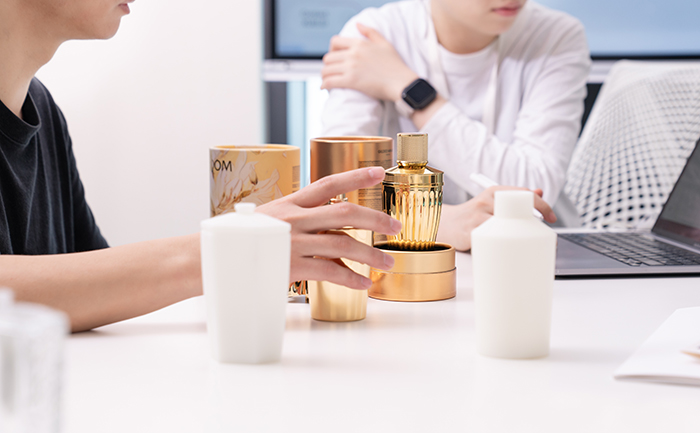
A safer first-run strategy is often to combine one hero scent, one supporting scent, and a discovery or sample format that allows consumers to try before committing to a full bottle.
Before signing a production agreement, the brand should clarify whether the MOQ applies to fragrance liquid, bottle style, bottle color, cap, pump, label, carton, or finished SKU. Sometimes the fragrance filling MOQ and packaging component MOQ are different.
If a custom cap or special coating has a higher component MOQ than the perfume filling MOQ, the brand may still need to purchase excess packaging inventory.
Understanding MOQ early helps avoid unexpected costs, production delays, and unsold inventory.