
How to Choose Candle Wax | Scent Throw, Burn Time, Compatibility
For scented jar candles, container paraffin, soy blends, coconut blends, and rapeseed-based waxes are the main options. Paraffin is usually easier to work with when strong scent throw matters. Soy and rapeseed blends suit vegetable-based candles. Coconut-rich blends often give a smooth finish, but softer formulas need heat testing. Pillars and molded candles need a harder wax that can hold its shape without a jar.
Two waxes with the same name can behave very differently. XUELEI checks the actual wax grade with the fragrance, wick, container, burn rate, and storage conditions before a formula moves forward.
Quick Comparison
| Wax | Common Use | Scent Performance | What to Check |
|---|---|---|---|
| Paraffin | Jars, pillars, wax melts | Often gives strong hot throw | Use the correct container or pillar grade |
| Soy | Jar candles | Varies with fragrance and wick | Frosting, rough tops, cure time |
| Coconut blend | Jar candles | Often works well with fragrance | Softening in warm storage |
| Beeswax | Tapers, pillars | Its own aroma can affect added fragrance | Wick size and batch variation |
| Rapeseed blend | Jars, melts | Varies by blend | Wax grade and process conditions |
| Palm wax | Pillars, decorative candles | Varies by formula | Crystal pattern and cooling |
Fragrance load is tied to the exact wax grade, not the wax family as a whole. Check the wax data sheet and the fragrance documentation before setting a percentage.
A name such as “coconut wax” also does not always mean pure coconut-derived wax. The product may contain soy, paraffin, or another wax. The same applies to many soy blends.
Choose by Candle Type
For jar candles, look at five things:
- fragrance compatibility;
- wick performance;
- melt-pool control;
- warm-storage stability;
- surface appearance after cooling.
Container paraffin, soy wax, coconut-soy blends, soy-paraffin blends, and rapeseed-based container wax are all common starting points.
Small gaps between the wax and glass are usually cosmetic. Wax can pull away from the jar as it cools or after temperature changes.
For pillar candles, hardness matters more. Check mold release, edge strength, shape retention, burn stability, and resistance to warm storage.
Hard paraffin, beeswax, palm wax, and dedicated pillar blends are better suited to this job.
For wax melts, there is no wick to worry about. Fragrance release, mold release, hardness, sweating, and break resistance matter more.
Scent Throw
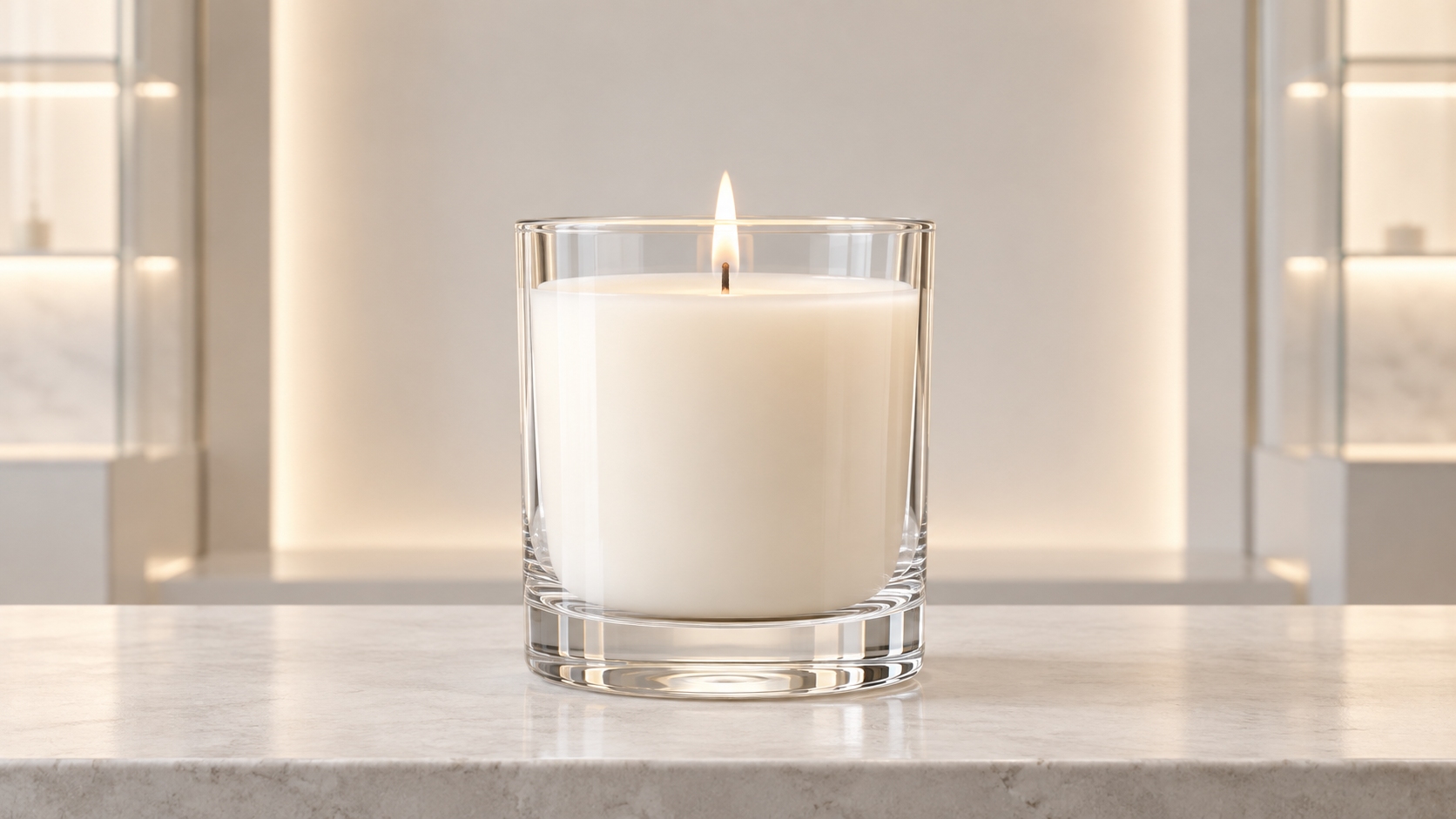
Cold throw is what the candle smells like before lighting. Hot throw is the scent released while it burns.
Hot throw changes with the fragrance, wax grade, fragrance load, wick size, jar diameter, melt-pool temperature, cure time, and process conditions.
A 7% formula can outperform a 10% formula if it burns steadily and releases fragrance well. Adding more oil can also create sweating or change the burn.
For comparison, burn every sample for the same length of time. A 2-hour test works for quick screening. A 4-hour burn gives more time to judge scent and melt-pool development.
- Use the same room.
- Keep ventilation similar.
- Burn every sample for the same time.
- Smell from roughly the same distance.
- Air the room between samples.
- Repeat the test during later burns.
- Use more than one evaluator where possible.
A 1-to-5 score is enough for internal comparison. The important part is using the same test conditions each time.
Leave a break between samples. Smelling several candles back to back can make later scents seem weaker.
Test Fragrance Loads
Start below the maximum load and work upward.
If 6%, 8%, and 10% are all allowed for the wax and fragrance, test all three:
| Test | Fragrance Load |
|---|---|
| A | 6% |
| B | 8% |
| C | 10% |
Keep the wax lot, fragrance, jar, wick, wax weight, cure time, mixing method, and pouring conditions the same.
Compare:
- cold throw;
- hot throw;
- sweating;
- flame stability;
- visible soot;
- melt-pool behavior;
- surface finish.
Once the fragrance load is fixed, test the wick again.
If 8% and 10% smell almost the same and the 8% candle also burns well, the higher load is hard to justify.
Moving from 8% to 10% uses 25% more fragrance:
(10 − 8) ÷ 8 × 100 = 25%
For every 100 kg of wax:
- 8% = 8 kg fragrance;
- 10% = 10 kg fragrance.
Calculate Fragrance
Use weight, not cups or teaspoons.
Fragrance load based on wax weight:
Fragrance weight ÷ wax weight × 100
With 920 g wax and 80 g fragrance:
80 ÷ 920 × 100 = 8.7%
If the target load is 8% and there is 1,000 g of wax:
1,000 × 0.08 = 80 g fragrance
Total batch weight:
1,000 g wax + 80 g fragrance = 1,080 g
The same 920 g wax + 80 g fragrance formula contains 8% fragrance by total finished weight:
80 ÷ 1,000 × 100 = 8%
Use the same calculation method on every batch sheet.
Paraffin
Paraffin grades are made for different jobs. Container wax, pillar wax, votive wax, and melt wax should not be treated as the same material.
On the supplier data sheet, check:
- intended use;
- melting or congealing range;
- fragrance load;
- oil content;
- hardness;
- process temperature.
A soft container grade may burn well in a jar but sag as a pillar. A hard pillar grade may shrink too much for a clear glass container.
Melting point alone does not tell you how long the candle will burn or how strong the scent will be.
Soy
Soy can develop frosting, rough tops, sinkholes, wet spots, cracking, or fragrance sweating.
Frosting is usually cosmetic. Wet spots appear when the wax pulls away from the glass, while sinkholes form as the wax contracts during cooling.
Visible fragrance oil matters more. It can point to too much fragrance, poor wax-fragrance compatibility, or storage that is too warm.
Check the same soy formula after 24 hours, 7 days, 14 days, and after warm and cool storage.
Soy does not automatically burn longer than paraffin. Measure the finished candle.
Coconut Blends
Coconut-rich blends are usually soft and can give jar candles a smooth, creamy surface.
Store test samples at 20–25°C and 30–35°C for 24–48 hours.
Check for:
- surface oil;
- softening;
- wax movement;
- wick movement;
- visible deformation.
“Coconut wax” may still contain soy, paraffin, or other waxes, so check the supplier's blend information.
Beeswax
Beeswax works well for tapers, pillars, unscented candles, and lightly scented candles.
Its natural smell can compete with light floral or clean fragrances. If that happens, changing the fragrance or wax often works better than simply adding more oil.
Color and aroma can also change with source and filtration.
Beeswax usually needs different wick sizing from soy or soft container wax.
Rapeseed
Rapeseed grades can differ in hardness, shrinkage, surface finish, fragrance capacity, pouring conditions, and cure behavior.
Moving from soy to rapeseed can also change the wick size, fragrance behavior, and process temperature. Treat the new wax as a new formula.
Palm Wax
Palm wax is hard and can produce visible crystal patterns.
The pattern changes with:
- pour temperature;
- mold temperature;
- room temperature;
- cooling speed.
If the crystal finish matters, compare several candles from the same batch before approving the look.
Burn Time
Measure burn time from wax use in grams per hour.
Estimated burn time = usable wax mass ÷ average wax used per hour
A candle with 220 g of usable wax that consumes 28 g in 4 hours burns at:
28 ÷ 4 = 7 g/hour
Estimated burn time:
220 ÷ 7 = 31.4 hours
Average several burn cycles because consumption can change as the wax level drops.
| Burn | Time | Wax Used | Burn Rate |
|---|---|---|---|
| 1 | 4 h | 26 g | 6.5 g/h |
| 2 | 4 h | 29 g | 7.25 g/h |
| 3 | 4 h | 31 g | 7.75 g/h |
Average burn rate:
(6.5 + 7.25 + 7.75) ÷ 3 = 7.17 g/hour
Estimated burn time:
220 ÷ 7.17 = about 30.7 hours
Some wax normally remains at the bottom, around the wick tab, or near the outer edge, so confirm the estimate with a full-life burn test.
When comparing waxes, wick each formula properly first. Using the same wick in every wax can give a false comparison.
Wick Size
A wick that is too small can cause:
- a weak flame;
- tunneling;
- poor hot throw;
- unused wax;
- a flame that eventually drowns.
A wick that is too large can cause:
- a tall flame;
- fast wax use;
- visible soot;
- heavy carbon buildup;
- too much container heat.
For a new wax or jar, test three wick sizes:
- the supplier's suggested size;
- the nearest smaller size in the same series;
- the nearest larger size in the same series.
A wick number in one series does not match the same number in another series.
Retest the wick after changing the wax, fragrance load, dye, fragrance, or container.
Jar Diameter
Use the inside diameter of the jar when choosing a wick.
Two jars can both hold 250 ml and still need different wicks:
- Jar A: 65 mm inside diameter, tall shape;
- Jar B: 85 mm inside diameter, short shape.
The 85 mm jar has a much wider wax surface. It may need a larger wick, another wick series, or two smaller wicks.
Jar shape matters too. A vessel that gets much wider below the opening may behave differently from a straight-sided jar.
Double Wicks
For a wide jar, compare one larger wick with two smaller wicks.
Record:
- flame size;
- soot;
- container heat;
- melt-pool coverage;
- wax left at the sides;
- wax left between the wicks.
Two small wicks do not behave like one larger wick, so test the actual setup.
Melt Pool
Record the candle after 1, 2, and 4 hours during a 4-hour development burn.
- melt-pool width;
- melt-pool depth;
- flame condition;
- wax left around the edge.
A full melt pool on the first burn is not required for every candle.
Do not increase the wick just to reach the edge quickly. Check the candle again in the middle and final part of its life.
Heat Test
Test at:
- 20–25°C;
- 30°C;
- 35°C;
- 10–15°C for a cool-storage check.
Check the warm samples after 24 and 48 hours.
- cracking;
- fragrance sweating;
- shrinkage;
- wax pulling away from glass;
- surface deformation;
- softening;
- wick movement.
Return the samples to room temperature for about 24 hours and inspect them again.
These temperatures are only screening points. If real shipping conditions are hotter, test the higher temperature.
Cure Time
Test the same batch after 1, 3, 7, and 14 days under the same conditions.
| Cure Time | Example Hot Throw Score |
|---|---|
| 1 day | 2/5 |
| 3 days | 3/5 |
| 7 days | 4/5 |
| 14 days | 4/5 |
If 7-day and 14-day samples repeatedly give the same result, 7 days is enough for that formula.
Repeat the check with other fragrances before setting one cure time for the full range.
Process Temperature
Use the heating, fragrance-add, and pouring ranges supplied for the exact wax grade.
Record:
- wax heating temperature;
- fragrance-add temperature;
- pour temperature;
- room temperature;
- container temperature;
- cooling conditions.
Change one process variable per test. If one batch is poured at 60°C and another at 70°C, keep the other main settings the same.
A wax that gives similar surfaces across repeated batches is easier to manage than one that only works inside a very narrow temperature window.
Check Compatibility
| Combination | What to Check |
|---|---|
| Wax + fragrance | Sweating, scent throw, softening, discoloration |
| Wax + wick | Flame size, soot, burn rate, unused wax |
| Wax + container | Diameter, melt pool, glass condition, heat |
| Wax + mold | Release, hardness, shape retention |
| Wax + dye | Appearance and wick changes |
| Wax + climate | Softening, cracking, sweating |
Test more than one fragrance family. At minimum, include a light or fresh scent, a floral scent, and a heavier woody or gourmand scent.
A wax may hold more fragrance than the fragrance documentation allows.
IFRA places candles of all types, including candles in containers, in Category 12. Check the documentation for the specific fragrance rather than using the wax supplier's maximum as a universal fragrance limit.[1]
If the fragrance limit is lower than the wax limit, use the lower figure and test the finished candle again.
Check Color
Fragrances containing vanillin can turn a white candle cream, yellow, tan, or brown over time.
Check the color again after 2–4 weeks instead of judging it only on the day of pouring.
Keep an approved sample if color consistency matters.
Test the Package
Pack test candles the same way they will be sent to customers.
Check:
- wax surface;
- lid contact;
- inner packaging;
- box;
- label.
Soft wax can mark a lid or insert. Fragrance may affect some packaging materials, and wax contraction can change the look of a clear jar.
Repeat the Test
Make at least three candles from the same batch.
Record:
- wax grade and lot;
- fragrance and lot;
- fragrance load;
- wick type and size;
- jar inside diameter;
- fill weight;
- pour date;
- cure time;
- burn duration;
- average burn rate;
- scent result;
- visible soot;
- storage result.
If the three candles behave differently, check wick position, fill weight, cooling, and raw-material lot before changing the formula.
Compare the Results
| Factor | Example Weight |
|---|---|
| Hot throw | 25% |
| Burn stability | 20% |
| Heat resistance | 15% |
| Appearance | 15% |
| Production consistency | 10% |
| Material cost | 10% |
| Glass appearance | 5% |
The weights above are only an example. A scented jar candle may put more weight on hot throw, while a candle shipped in hot weather may put more weight on heat resistance.
Check the Cost
Compare the cost of the finished wax-and-fragrance fill, not just the wax price per kilogram.
Both examples below use a final fill weight of 200 g.
Wax A
- wax: $3.00/kg;
- fragrance load: 8% of wax weight;
- fragrance: $30/kg.
Wax weight = 200 ÷ 1.08 = 185.2 g
Fragrance = 185.2 × 0.08 = 14.8 g
Wax cost = 0.1852 × $3.00 = about $0.56
Fragrance cost = 0.0148 × $30 = about $0.44
Total = about $1.00 per candle
Wax B
- wax: $3.80/kg;
- fragrance load: 10% of wax weight;
- fragrance: $30/kg.
Wax weight = 200 ÷ 1.10 = 181.8 g
Fragrance = 181.8 × 0.10 = 18.2 g
Wax cost = 0.1818 × $3.80 = about $0.69
Fragrance cost = 0.0182 × $30 = about $0.55
Total = about $1.24 per candle
The difference is about $0.24 per candle, or roughly $2,364 across 10,000 candles.
Ask the Supplier
- intended use;
- melting or congealing range;
- fragrance load;
- process temperatures;
- hardness;
- blend composition;
- storage advice;
- lot identification;
- technical data sheet;
- COA availability.
A technical data sheet describes the normal properties and processing range of the wax.
A COA reports selected results for one production lot; it does not test compatibility with the fragrance, wick, or jar.
Reject a Poor Match
Change the wax if repeated tests still show:
- fragrance sweating;
- severe cracking;
- unstable burning;
- excessive soot;
- poor scent throw;
- large batch differences;
- deformation in realistic heat;
- a process that is difficult to repeat.
First rule out the fragrance, wick, container, and process. If the same problem appears in three repeat tests, try another wax.
Safety Test
Burn the candle through its useful life.
Record:
- burn duration;
- flame stability;
- visible soot;
- carbon buildup;
- melt-pool behavior;
- container condition;
- wax consumed;
- behavior near the bottom.
Use containers made for candle use. A drinking glass or decorative household jar should not be assumed to handle repeated candle heat.
In the United States, CPSC guidance states that metal-cored candlewicks and candles using them must not contain lead in the metal core above 0.06% by weight. The CPSC also notes that candles containing hazardous substances may need cautionary labeling under the Federal Hazardous Substances Act.[2]
The CPSC also lists voluntary ASTM standards covering candle fire-safety labeling, fire safety, visible emissions, and glass containers. These include ASTM F2058, F2417, F2326, and F2179.[3]
There is no single flame-height, jar-temperature, or melt-pool limit that applies to every candle.
FAQ
Can two candle waxes be mixed?
Yes. The blend becomes a new formula, so hardness, shrinkage, scent throw, surface finish, and wick needs can all change. A 50/50 blend does not necessarily behave halfway between the two original waxes.
Can the same wick be used after changing wax?
Use it as a starting point only. Test the same wick together with the nearest smaller and larger sizes in the same series.
Does a higher melting point mean a longer burn?
No. Burn time also depends on the wick, fragrance, jar diameter, melt behavior, and heat buildup. Measure wax use in grams per hour instead.
Is the maximum fragrance load the best fragrance load?
No. Moving from 8% to 10% uses 25% more fragrance. If scent and burn performance stay almost the same, the extra oil only adds cost.
Is a pure wax better than a blend?
No. A blend may improve hardness, scent throw, surface finish, or heat resistance. Judge the finished candle, not the word “pure.”
Finally
For jar candles, compare the exact wax grade with the final fragrance, wick, and container. An 8% fragrance formula that burns steadily, survives 30–35°C storage, and keeps a good hot throw is a better choice than a 10% formula that only smells slightly stronger. Measure burn rate in g/hour, test more than one wick size, and repeat the same formula across several candles. XUELEI compares scent, burn rate, heat resistance, and storage results before a wax moves into production.