
Solid Perfume Packaging | Tin, Compact, Twist-Up Formats
For a soft solid perfume, a tin is usually the easiest option. A compact works well when the product needs a refillable or more detailed case, while a twist-up tube is better for direct application if the formula is firm enough. Even with the same 5 g fill, these packages can feel very different in daily use. A shallow tin is easy to reach, a compact has more parts that can wear out, and a twist-up stick needs the right balance of hardness, support and heat resistance.
Tin vs Compact vs Twist-Up
| Point | Tin | Compact | Twist-Up |
|---|---|---|---|
| Example small fill | 5-10 g | 5-10 g | About 5 g |
| Application | Finger | Finger | Direct to skin |
| Soft balm | Very suitable | Suitable | Usually needs formula adjustment |
| Main structure | Usually base + lid | Often 4-7 functional parts | Multi-part moving mechanism |
| Main heat problem | Product reaches lid or thread | Oil reaches pan, hinge or adhesive | Stick bends, smears or breaks |
| Filling difficulty | Low | Low to medium | Medium to high |
| Refill design | Possible | Easiest of the three | Depends on mechanism |
| Near-empty access | Good if shallow | Depends on pan depth | Depends on mechanism |
The fill sizes in the table are examples, not fixed industry sizes. A 5 g package can still be wide, narrow, shallow or deep. The shape of the container and the way the formula behaves inside it are more important than the number on the label.
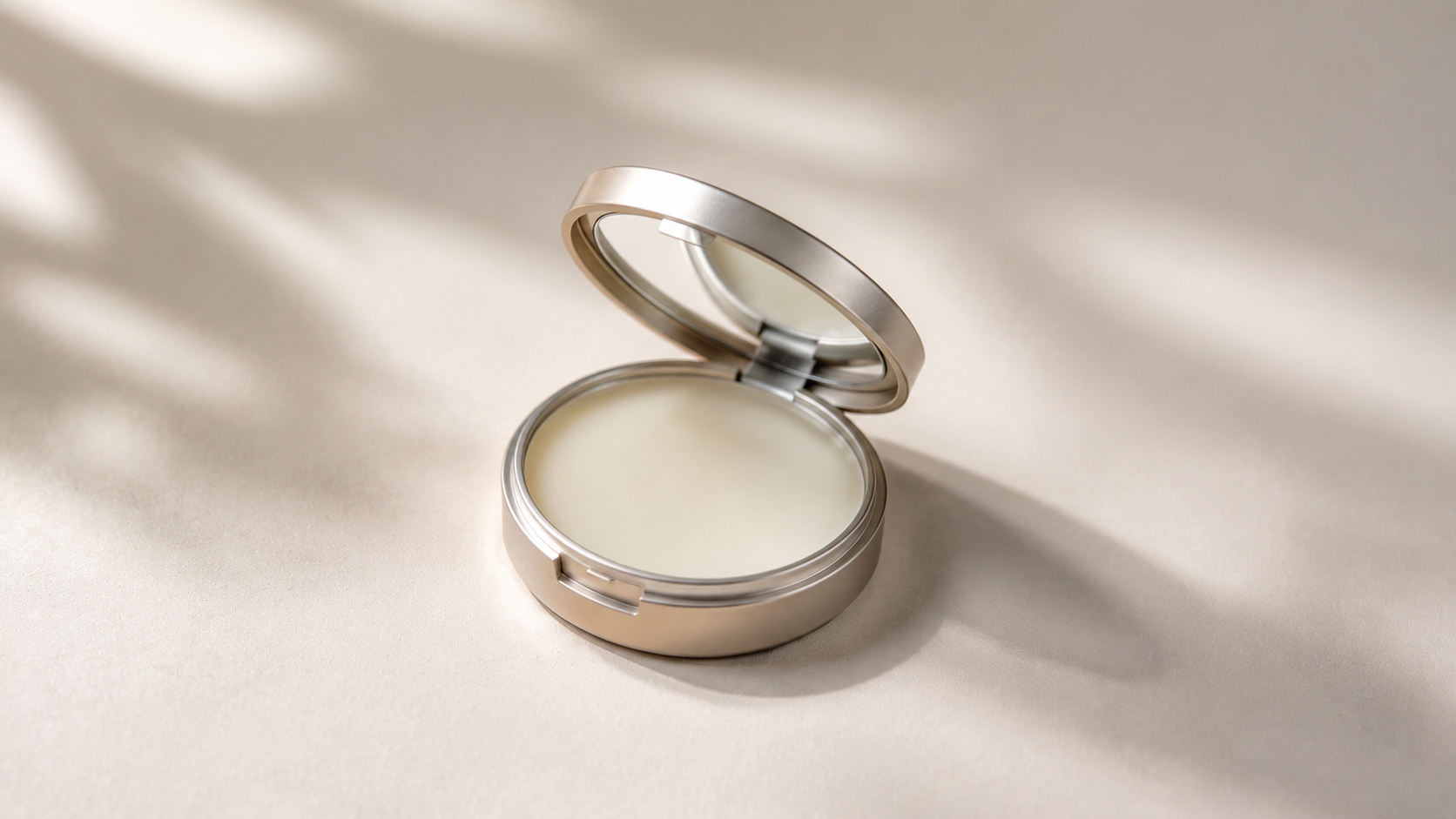
Match the Package to the Formula
Most solid perfumes use a mix of waxes, carrier oils, plant butters and fragrance materials. Change the balance and the product may become harder, softer, oilier or easier to spread.
- Tin: the container supports the balm from the bottom and sides.
- Compact: the balm is supported too, but it also needs to stay clear of the pan edge, hinge and closure.
- Twist-up: part of the perfume sits above the tube while it is being used, so the stick needs enough strength to hold itself up.
A balm that works perfectly in a tin may be too soft for a twist-up tube. The opposite can happen as well: making a formula very firm for a stick can make it harder to pick up with a finger if the same formula is put into a tin.
Different scents can also change the finished texture. Two fragrances may use the same wax-and-oil base but still end up with different softness, color or package compatibility.
XUELEI treats formula work, package testing, filling and finished-product checks as connected steps in its perfume manufacturing process. Fragrance use levels also depend on the finished product category. IFRA applies its Standards according to intended use rather than using one fragrance limit for every type of product.[1]
Check Scent Loss in the Package
If a solid perfume smells weaker or different after storage, it helps to compare three samples:
- a freshly filled sample;
- a retained sample kept under normal conditions;
- the same perfume stored in the final package.
Look for weaker top notes, a stale or oily smell, color changes or a drier surface. These changes do not automatically mean the package is at fault. Time, heat, raw materials and storage can also affect the perfume.
The closure is another part to inspect. A lid may feel tight without providing a particularly good seal. Screw threads, snap closures, liners and gaps around moving parts can all change how much air reaches the product over time.
XUELEI discusses similar causes in its article on why perfume samples can smell different, including storage, raw-material variation and contact with packaging.
EU cosmetic safety guidance notes that the formula, packaging and outside environment can affect the finished product and that movement between the formula and package should be considered.[2]
Use Tins for Softer Balms
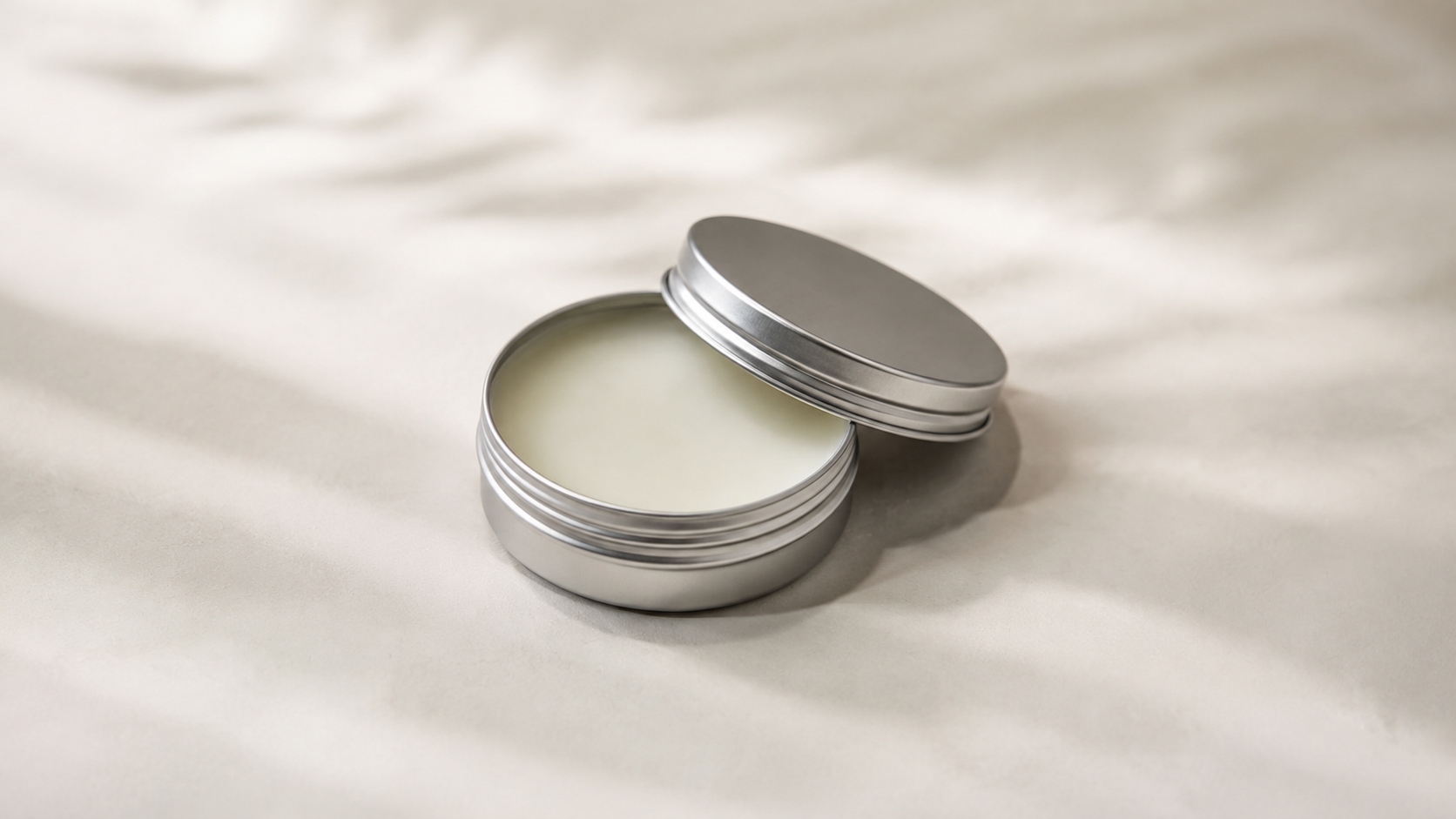
A basic tin can be very simple: one base and one lid. With fewer moving parts, there are also fewer things that can loosen or break.
The shape of the tin still makes a big difference. Put the same 5 g of perfume into two different containers and they may feel nothing alike.
- A wide, shallow tin gives the finger more surface to swipe.
- A deep tin becomes harder to reach as the perfume runs low.
- Sharp corners can leave product that is difficult to pick up.
Use the sample long enough to see what happens when it is full, about half-used and nearly empty. The last stage often shows problems that are invisible when the tin is new.
Check the Metal and Coating
Not every package sold as a “tin” uses the same metal. Small perfume containers may be made from tinplate steel, aluminum or another coated metal.
The name of the metal does not tell the whole story. Wall thickness, shape, coating and the way the container is made all affect weight, denting and long-term performance.
Useful questions for the packaging supplier include:
- What metal is the container made from?
- Is there a coating on the inside?
- What coating is used?
- Does the lid use the same material?
- Are changes to product-contact materials controlled?
FDA notes that the composition of a cosmetic container can affect product safety, so the material should not be chosen only by appearance.[3]
Choose the Tin Lid Carefully
| Lid Type | Main Advantage | Main Problem to Test |
|---|---|---|
| Screw-top | Clear, secure closure | Product entering the thread |
| Sliding | Thin pocket format | Becoming too loose or too tight |
| Push-on | Simple construction | Lid loosening or coming off |
A screw-top tin can work very well until softened balm reaches the thread. Once oil and wax build up there, the lid may collect dirt or become harder to turn.
It is also worth opening the tin with slightly oily fingers. A smooth metal lid that feels fine with dry hands can be surprisingly difficult to grip just after the perfume has been applied.
Sliding and push-on lids need a different test. Carry the filled tin, press it against other items and open it repeatedly. Small dents can change the fit even when the empty sample originally worked well.
Check Compact Failure Points
A compact can have 4-7 functional parts, depending on its design. These may include the outer case, lid, hinge, closure, perfume pan, mirror and retaining insert.
Each extra part gives the package another place where something can go wrong.
- Does the hinge become loose?
- Does the pan move?
- Does the magnet stay in place?
- Does the snap still close properly?
- Does adhesive soften?
- Does the mirror stay attached?
- Does the finish scratch easily?
- Does oil move outside the pan?
A mirror can make the compact feel more like a beauty product, but it does not make the perfume easier to apply. It also adds weight and another part that can come loose or break.
XUELEI's OEM and ODM fragrance guide explains how stock, semi-custom and fully custom packaging can change MOQ, cost, lead time and development work.
Avoid Deep, Hard-to-Reach Pans
| Pan Shape | What It Feels Like to Use |
|---|---|
| Wide and shallow | Easy finger access, including near the bottom |
| Narrow and deep | Harder to reach and more product around fingernails |
| Rounded bottom | Less product trapped in corners |
| Sharp bottom corners | More product may be left behind |
Use the compact at 100% fill, around 50% remaining and close to empty. These are practical checkpoints, not formal industry limits. They simply show whether the package stays easy to use throughout its life.
Test the Twist-Up Mechanism
Twist-up packaging is convenient for people who do not want balm on their fingers. Small formats can be around 5 g, although the exact size can vary.
The mechanism matters more than the capacity. Five simple checks usually reveal most obvious problems:
- Does the stick rise smoothly?
- Can it move back down if the design allows it?
- Does the mechanism become loose after repeated use?
- Does perfume get into the moving parts?
- Is there enough room between the top of the stick and the cap?
A stick that is hard to retract can easily end up pressed into the cap if the customer raises too much product.
Balance Stick Hardness and Product Transfer
A good perfume stick cannot simply be “hard.” It also has to feel good on skin.
If it is too soft:
- it may bend;
- smear around the tube;
- break;
- or stick to the cap.
If it is too hard:
- it may drag on the skin;
- need too much pressure;
- transfer too little balm;
- and make the fragrance seem weaker than it really is.
During a normal use test, see whether one or two swipes leave a useful amount of balm on the skin. This is a practical test point rather than an industry rule.
Do Not Overextend the Stick
Try the stick at three heights:
- just above the rim;
- the height someone would normally use;
- farther out than necessary.
The last test is useful because customers will not always use the package perfectly. If the stick bends or breaks as soon as it is raised a little too far, the package has very little room for normal user error.
Stick width also changes how the perfume feels. A narrow stick gives more control on the wrists, neck and behind the ears. A wider stick covers more skin but can start to feel more like a deodorant format. Round sticks are simple, while oval sticks offer a little more contact area without making the whole tube wider.
Separate Softening from Oil Sweating
| Problem | What It Looks Like |
|---|---|
| Softening | The perfume becomes less firm but stays mostly in place |
| Melting | The product loses enough structure to move or flow |
| Oil sweating | Liquid oil appears while most of the balm remains solid |
| Migration | Oil or balm moves into the lid, hinge, thread or mechanism |
These are four different problems. Treating all of them as “melting” makes it harder to find the real cause. Adding more wax, for example, may make the balm harder but still leave an oil-migration problem unsolved.
Run Five Storage Checks
There is no single temperature that every solid perfume must pass. The test should match the actual formula, package, sales market and transport conditions.
ISO/TR 18811 describes a product-specific approach to cosmetic stability testing rather than one universal test condition.[4]
| Condition | What to Look For |
|---|---|
| Normal storage control | Scent, surface and closure |
| Cool storage | Cracking, hardness and product transfer |
| Warm storage | Softening, oil release and movement |
| Warm/cool cycling | Recovery and lasting changes |
| Side storage | Movement toward the lid, seam or mechanism |
For each condition, note four things:
- how the product looks;
- whether the package still works;
- whether the perfume returns to normal after the test;
- whether any oil or balm stays in the lid, hinge, pan or mechanism.
EU cosmetic safety guidance also says stability should be considered under reasonably foreseeable storage conditions.[5]
Test Each Format While Warm
Tin: look for softened balm around the rim and thread. Side storage is especially useful because the product may stay clean when upright but reach the lid when laid flat.
Compact: look around the pan edge, hinge, adhesive and decorative parts for oil or softened balm.
Twist-up: use the stick while it is still warm. If it is allowed to cool completely first, bending or smearing that would happen during a warm delivery may disappear before anyone sees it.
Check Package Compatibility Both Ways
The perfume can damage the package, but the package can also change the perfume.
| Perfume Can Affect the Package | Package Can Affect the Perfume |
|---|---|
| Plastic swelling | Plastic-like smell |
| Cracking | Coating-related smell |
| Coating damage | Color change |
| Corrosion | Scent change |
| Adhesive lifting | Visible residue |
If one fragrance passes a packaging test, that does not automatically mean every fragrance in the range will behave the same way.
Use a Five-Sample Compatibility Set
A simple set can include:
- a retained reference;
- a normally stored packaged sample;
- a warm-stored sample;
- a cool-stored sample;
- a side-stored sample.
Compare seven things:
- scent;
- color;
- texture;
- visible oil;
- closure fit;
- package shape;
- product-contact surfaces.
If a range contains many fragrances, it makes sense to pay extra attention to formulas with higher fragrance load, softer texture, more oil movement or strong color when staining is a concern.
Keep Finger Application Practical
Tins and compacts normally need finger application. FDA notes that fingers can introduce microorganisms into cosmetics and advises clean hands when using cosmetic products.[6]
The opening should be wide enough for a normal swipe without forcing the customer to scrape the perfume with a fingernail.
A twist-up stick keeps fingers away from the main balm, although the stick still touches the skin. For shop testers shared by many people, a separate sampling method is more suitable.
Check Filling Defects Before Scale-Up
The same formula can look different when it is poured into a different package. Metal thickness, pan depth, plastic construction and stick size all change how the product cools.
Common problems include:
- bubbles;
- sink marks;
- surface cracks;
- shrinkage;
- product pulling away from the wall;
- weak stick anchoring.
XUELEI's perfume manufacturing process covers formula work, filling, packaging and finished-product inspection as connected production steps.
ISO 22716 covers cosmetic production, quality control, storage and shipment.[7]
Use Different Filling Checks for Each Format
Tin: look at fill weight, bubbles, sink marks, cracks, oil sweating, balm on the rim and cooling consistency.
Compact: decide whether it is better to fill the pan before or after it goes into the outer case. Filling first can keep heat and residue away from mirrors, magnets and decorative finishes.
Twist-up: look for empty spaces, hollow centers, shrinkage, cracks and weak anchoring. A smooth-looking top does not prove that the lower part of the stick is secure.
Leave Enough Headspace
Before the final fill level is set, answer three simple questions:
- Can the package close without touching the perfume?
- Does the perfume stay away from the lid or closure when stored on its side?
- Does it still stay clear after warm storage?
There is no one headspace measurement that works for every container.
Check Label Space Before Printing
Small solid perfume packs can run out of usable label space quickly. Depending on the market, the pack may need product identity, net contents, ingredients, responsible-business information and required warnings.
FDA provides cosmetic labeling requirements for products sold in the United States.[8] ISO 22715 also covers cosmetic packaging and labeling.[9]
A curved or embossed lid may look large but still leave very little flat area for readable text. A bottom label, peel-back label, sleeve or outer carton can provide more room.
Compare Finished Cost, Not Empty Pack Price
| Cost Area | Tin | Compact | Twist-Up |
|---|---|---|---|
| Primary package | Low to medium | Medium to high | Medium |
| Decoration | Low to medium | Medium to high | Medium |
| Assembly | Low | Medium to high | Medium |
| Filling difficulty | Low | Medium | Medium to high |
| Tooling exposure | Usually lower with stock tins | Can be high | Can be high |
A cheap empty container is not always the cheapest finished package. Printing, assembly, cartons, filling and rejected parts all add cost.
Tin cost is usually affected by the metal, shape, printing and lid. Compact cost changes with the pan, mirror, magnet and number of parts. Twist-up packaging depends heavily on the mechanism, material, tooling and filling process.
XUELEI's OEM vs. ODM fragrance guide explains how stock, semi-custom and custom packaging can lead to different costs, MOQs and lead times.
Split MOQ Into Five Numbers
One packaging MOQ does not tell the full story. Ask separately for:
- stock package MOQ;
- printing MOQ;
- custom color MOQ;
- decoration MOQ;
- custom mold MOQ.
These numbers may be very different. A custom package can look better on a sample but still leave too much unused stock if its minimum order is much larger than the first production run.
Test the Full Product Life
| Stage | What to Look For |
|---|---|
| New | Fill, appearance, closure and first application |
| After carrying | Dents, scratches and accidental opening |
| After repeated use | Thread, hinge, magnet and mechanism wear |
| Nearly empty | Access to the remaining perfume |
Transport testing should use filled retail packs. An empty container cannot show a broken perfume stick, oil on a label, balm under a lid or product moving around a pan.
For an everyday-use check, carry the package with normal bag items such as keys, a phone and other cosmetics. This quickly shows scratching, pressure damage and weak closures.
Make Refills Easy to Remove but Hard to Lose
A refillable compact has to do two opposite things well. The refill should come out easily when someone wants to replace it, but it should stay firmly in place during normal use.
Try the refill during:
- normal opening;
- carrying;
- upside-down storage;
- drops;
- warm storage;
- repeated replacement.
Magnets, clips and press-fit systems can all work, as long as the refill does not become loose after repeated changes.
Do Not Judge Sustainability by Material Name
A metal tin is not automatically better for the environment than plastic, and a refillable compact is not automatically low-waste.
Look at the whole package:
- total weight;
- number of materials;
- coatings and adhesives;
- whether parts can be separated;
- secondary packaging;
- shipping volume;
- whether customers actually buy and use refills.
A heavier reusable compact makes more sense when the same case stays in use through several refills. If it is thrown away after the first pan, much of the reason for making it refillable is lost.
Find the Cause of Common Failures
| Problem | Likely Causes | Check First |
|---|---|---|
| Tin will not open | Product in thread, denting, poor lid fit | Warm side storage |
| Tin opens in bag | Loose fit, weak sliding resistance, deformation | Carry and compression test |
| Compact cracks | Material, hinge, wall thickness, impact | Where the crack begins |
| Pan comes loose | Poor fit, adhesive, heat | Warm storage and repeated use |
| Stick breaks | Soft formula, weak anchoring, extension, heat | Warm application test |
| Stick drags | Formula too hard or low slip | Product transfer |
| Perfume hits cap | High fill, poor retraction, soft formula | Cap clearance |
| Scent changes | Storage, oxidation, raw material or package | Retained control |
| Oil stains packaging | Sweating or migration | Where the oil first appears |
Choose the Format by Product Need
| Product Need | Better Starting Point | Reason |
|---|---|---|
| Soft balm | Tin | The formula is fully supported |
| Small 5 g travel format | Tin or twist-up | Both can stay compact |
| Refillable perfume | Compact | A removable pan is easy to build around |
| Gift or decorative product | Compact | More room for case details |
| Finger-free application | Twist-up | Direct skin application |
| Discovery set | Small tins | Simple multi-scent packing |
| Low-complexity first launch | Stock tin | Fewer parts and less tooling |
| Warm-market product | Formula-dependent | Warm testing should decide |
Check These 10 Points Before Mass Production
- finished formula and package compatibility;
- warm storage;
- cool storage;
- side storage;
- closure or mechanism performance;
- fill level;
- oil movement;
- scent and color changes;
- transport and repeated-use damage;
- access when the product is nearly empty.
Keep a retained control sample so scent, color and texture changes have something to be compared with. XUELEI's guide to GMP controls in perfume manufacturing covers packaging specifications, incoming inspection, batch records, change control and final release. ISO 22716 provides the wider GMP framework for cosmetic production, control, storage and shipment.[10]